Know what your building is doing — room by room, second by second.
SapienOS is an AI sensor platform for smart, healthy, resilient buildings. Multi-modal sensors feed an intelligent edge gateway that authenticates every reading, detects anomalies on the spot, and serves it all through an open, queryable API.
From sensor to insight in three layers
Sense
Wired and wireless sensor modules capture air quality, gas, light and pressure signals — with structural sensing in development. Every module has its own cryptographic identity — no anonymous data.
Edge
A gateway in the building authenticates and signs each reading, buffers through outages, and runs anomaly detection and alarm logic locally — insight doesn't wait for the cloud.
Twin
Data lands in an open SensorThings API, ready for dashboards, reporting and a BIM/IFC digital twin — a living model of the building, not a folder of spreadsheets.
The platform under it all
Honest AI, authenticated data and open standards — and every claim on this page runs on real hardware in our pilot lab.
Edge AI, honest alarms
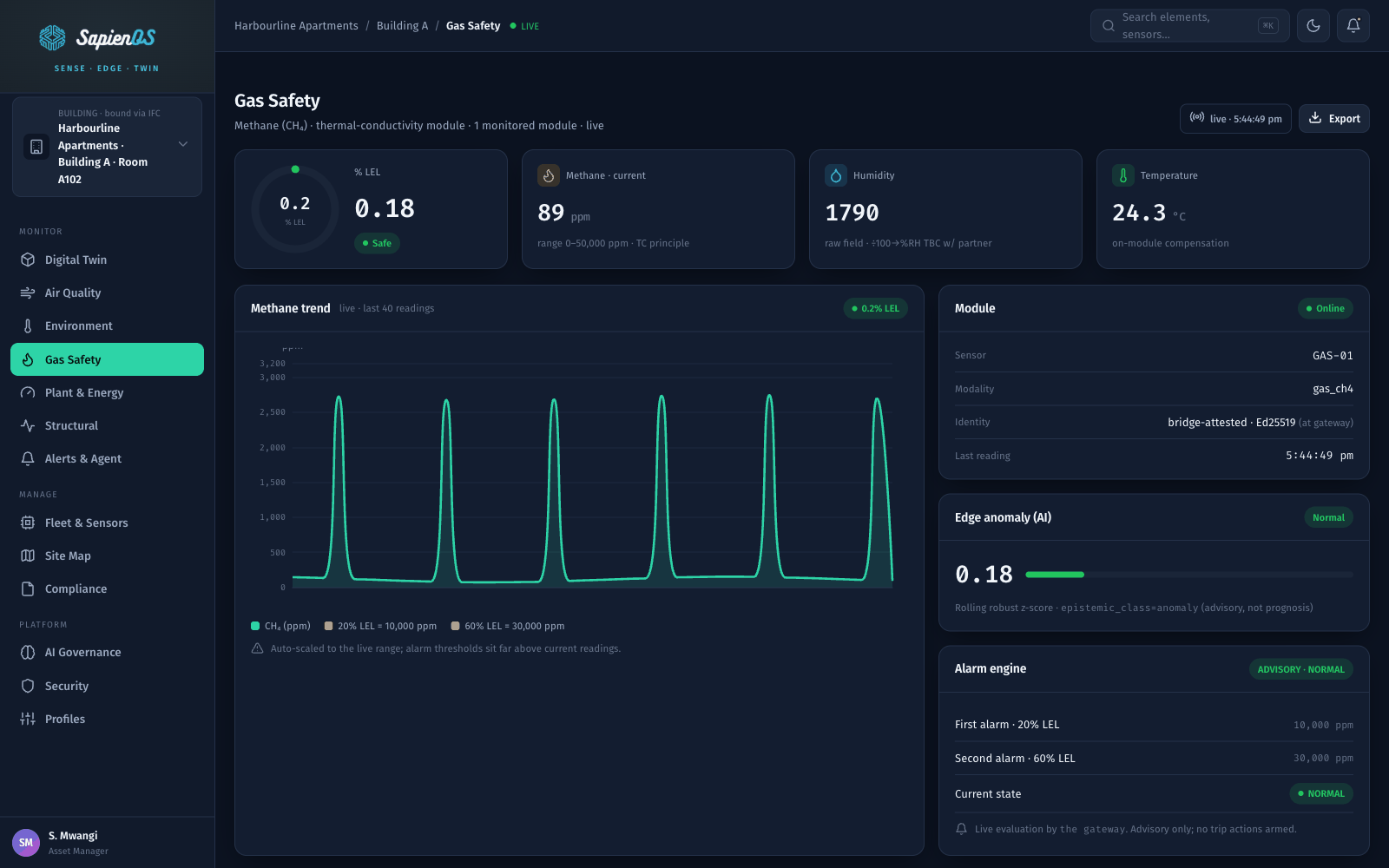
Anomaly detection runs on the gateway and flags unusual behaviour in seconds — while alarm decisions stay simple, auditable threshold logic. AI advises; it never overrides.
Trustworthy data
Per-device keys, replay protection and gateway signing on every reading. Security aligned to IEC 62443 zones and conduits — designed in, not bolted on.
Open standards
Data is served through the OGC SensorThings API — queryable by any client, integrable with any BMS or analytics stack. No lock-in.

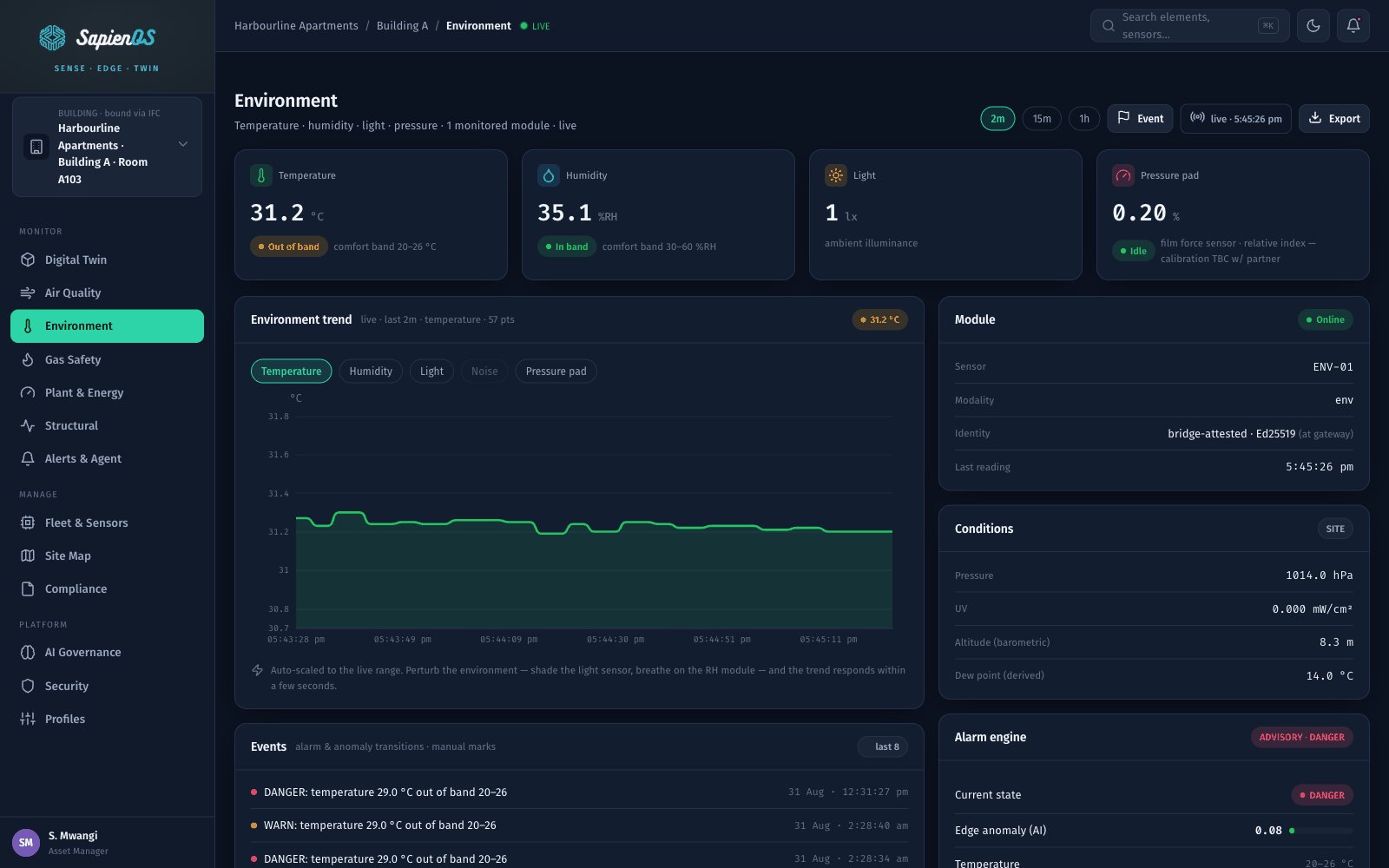
Before the pitch deck, we built the bench.
SapienOS runs end to end on real hardware in our pilot lab — real sensors feeding a real edge gateway, every reading authenticated and signed on its way to the same live consoles you can open in the demo. The numbers further down this page were measured on that bench, not modelled. And the architecture that makes it hold — edge AI, security model, open API — is the platform itself.
See how it's builtThree ways to listen to a building

Indoor environment & air quality
Temperature, humidity, light and pressure with comfort-band alarming today; CO₂, particulates and VOC channels on the sensor roadmap. Healthy rooms, provably.
Live in pilot
Gas safety
Methane detection built on a proven thermal-conductivity sensor with a decade of field heritage — %LEL visibility, advisory alarm levels, full audit trail.
Live in pilot
Structural health
Vibration and modal analysis to hear how a structure's condition changes over time — time-synchronised sensing designed for micro-second-class alignment.
In developmentBuilt for the assets you answer for
A bridge, a tunnel and an office tower go wrong on different clocks — and all leave you answering for them. Pick the setting that sounds like yours.

Roads & bridges
Curing, conditions and the record, from first pour to final inspection.
Learn more →
Tunnels & underground
Gas, air and water ingress, watched before anyone opens the door.
Learn more →
Airports
Start with one plant room, grow across the whole estate.
Learn more →
Commercial buildings
Air quality tenants can see — and your ratings reflect.
Learn more →Running on real hardware, today
The platform is live in our pilot deployment — real sensors, a real edge gateway, real cellular backhaul, watched by the real AI.
See this exact system watching your building.Live sensors, live AI, no slides — pilot partnerships now open.
Join the pilot programmeQuestions, answered plainly
What does it monitor?
Today: indoor environment (temperature, humidity, light, pressure) and methane gas safety, both live in pilot. On the roadmap: CO₂, particulates and VOCs for full indoor-air-quality coverage, and structural health monitoring via vibration and modal analysis.
How does the edge AI work — and can I trust an AI alarm?
Anomaly detection runs on the gateway, next to the sensors, flagging unusual behaviour within seconds — typically well before a fixed threshold would trip. But alarm decisions themselves remain simple, auditable threshold logic: the AI can raise attention, and can never suppress or downgrade an alarm. Every AI output is labelled advisory.
Is the sensor data secure?
Every reading is authenticated at the gateway using a per-device key with replay protection, then cryptographically signed before storage. The security architecture follows IEC 62443 zones-and-conduits principles.
Will it lock us into a proprietary system?
No. Data is served through the OGC SensorThings API — an open standard — so any dashboard, BMS integration or analytics tool can query it. Building models follow IFC/BIM open standards on the digital-twin roadmap.
Can it help reduce our energy costs?
Today SapienOS measures and monitors. On the roadmap is supervised energy optimisation: pairing with your existing BMS over open protocols (BACnet/IP) to surface chiller, ventilation and lighting savings opportunities that a person approves before anything changes — your BMS stays in control, and every action is bounded and logged. We publish measured results, not projected percentages; no automated control is available today.
Your building could be first.
Tell us about your building on the pilot page — live data, live AI, no slides. Pilot intake is limited and open now.